

How You Benefit From Scottsdale’s Well-Equipped Dental Implant Center
Dental implants have transformed from experimental procedures into predictable, long-lasting tooth replacements. Yet success hinges on one critical factor: knowing exactly what lies beneath the gums before surgery begins. Cone Beam Computed Tomography (CBCT) scanning changed everything. This 3D imaging technology maps jawbone density, nerve pathways, and sinus cavities with millimeter precision.
At Pristine Dental, our dental clinic in Scottsdale, Dr. Keith Cooper and Dr. Stephanie Smith use CBCT to plan every implant case digitally before touching a surgical drill. Patients from Phoenix, Paradise Valley, and Fountain Hills benefit from safer surgeries, faster healing, and implants positioned for maximum longevity. Call Pristine Dental at (480) 935-2424 now to schedule your appointment.
What is CBCT Scanning?
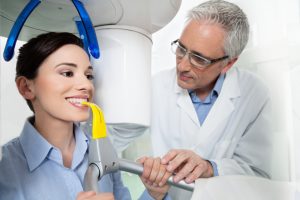 Cone Beam Computed Tomography emerged in the late 1990s specifically for dental applications. Unlike medical CT scanners, CBCT units focus exclusively on the head and neck region, delivering higher resolution images at significantly lower radiation doses.
Key advantages of CBCT technology:
- Lower radiation exposure – Equivalent to a cross-country flight, far less than medical CT
- Higher resolution – Captures details down to 0.125mm
- Quick scanning – Takes just 10-40 seconds with no claustrophobic tunnels
- Immediate results – Digital images available instantly for treatment planning
Pristine Dental’s CBCT unit provides submillimeter accuracy, revealing anatomical details invisible on standard X-rays. Dr. Smith uses this technology to measure bone density, predict osseointegration speed, and determine whether bone grafting is necessary before surgery.
The Advantage Over Traditional X-Rays
Traditional dental X-rays show flat, two-dimensional images that hide crucial anatomical details. Surgeons estimated bone depth and guessed nerve locations, increasing complication risks. CBCT eliminates guesswork. The scanner rotates around your head in seconds, capturing hundreds of images from multiple angles. Software reconstructs these into a complete 3D model of your jaw, teeth, and surrounding structures.
How CBCT Revolutionized Implant Planning
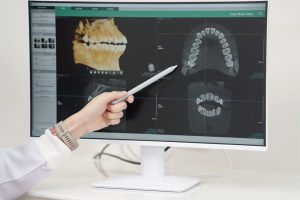 Before CBCT became standard, planning dental implants involved significant guesswork. Surgeons relied on flat X-rays that compressed three-dimensional anatomy into two dimensions. These limitations created serious problems.
Common complications from outdated 2D imaging:
- Nerve damage causing numbness in the lips or chin
- Sinus perforations requiring corrective procedures
- Implants placed at poor angles compromise aesthetics
- Failures due to undetected insufficient bone quality
- Mid-surgery surprises extend procedure time
CBCT transformed this landscape. Dr. Cooper examines every case from multiple perspectives—axial, sagittal, and coronal views—before developing the surgical plan.
Oral Surgery Guides for Ultimate Precision
CBCT data enables the creation of surgical guides. These custom templates direct drill placement with extraordinary accuracy. Dr. Smith designs ideal implant positions virtually, then exports the plan to a 3D printer that fabricates a biocompatible guide.
Benefits of guided implant surgery:
- Implants placed within 1mm of the planned position
- Shorter surgery time
- Less tissue trauma and swelling
- Many cases require no sutures
- Reduced complications
During surgery, the guide eliminates freehand drilling. Dr. Cooper follows the predetermined path, ensuring precision. Patients experience minimal post-operative discomfort and faster recovery.
Enhanced Safety During Dental Procedures
Two structures demand respect during implant surgery: the inferior alveolar nerve in the lower jaw and the maxillary sinuses in the upper jaw.
Lower jaw nerve protection:
- CBCT maps the nerve’s exact three-dimensional path
- Reveals variations that standard X-rays miss
- Allows precise measurement of safe drilling depth
- Prevents numbness and pain
Upper jaw sinus management:
- Shows the exact sinus floor position
- Measures the available bone height
- Identifies when sinus lifts are necessary
- Prevents membrane perforation
Dr. Smith evaluates these critical structures during planning, making all decisions before surgery rather than discovering problems mid-procedure.
Bone Quality Assessment Before Dental Implant Treatment
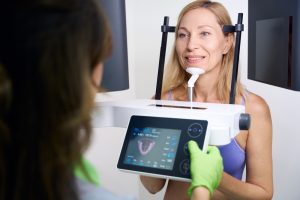 CBCT software analyzes bone density using grayscale values. Dr. Cooper categorizes bone quality from Type I (dense cortical) to Type IV (sparse trabecular), predicting osseointegration speed and initial stability.
Common grafting scenarios identified through CBCT:
- Horizontal ridge deficiencies (jaw too narrow)
- Vertical deficiencies (insufficient height)
- Socket preservation after tooth extraction
- Sinus floor elevation needs
Each scenario gets precisely diagnosed based on three-dimensional data. The CBCT images show exactly where grafting is needed and how much augmentation is required.
Immediate Dental Implant Placement
Modern dentistry favors immediate placement—inserting the implant during the same appointment as extraction. CBCT scanning before extraction reveals whether this approach is feasible by evaluating root anatomy, surrounding bone thickness, and socket dimensions.
Patient benefits:
- Single appointment for extraction and implant
- Preserved socket architecture
- Reduced treatment time
- Better gum tissue contours
- Less bone resorption
Dr. Cooper positions the implant optimally during extraction, compensating for future bone remodeling. CBCT guidance ensures proper positioning despite altered anatomy.
Pristine Dental’s Technology Advantage
Dr. Keith Cooper and Dr. Stephanie Smith invested in cutting-edge dental technology because predictable outcomes require accurate information. Every implant consultation includes comprehensive imaging when indicated.
Pristine Dental’s digital workflow:
- CBCT scanning for 3D visualization
- Intraoral scanning for digital impressions
- CAD/CAM design for custom components
- 3D printing for surgical guides
- Digital smile design for aesthetics
The doctors review scans with patients, explaining anatomy and options. This transparency builds confidence and ensures informed decisions. Patients throughout Scottsdale choose Pristine Dental for this technological advantage.
Experience the Difference That Advanced Imaging Makes at Pristine Dental
If you’re considering dental implants, the technology your dentist uses dramatically impacts your outcome. CBCT scanning eliminates guesswork, reduces complications, shortens treatment time, and improves long-term success rates.
Whether you need a single implant to replace one tooth or a full-arch Stabili-Teeth™ restoration, Pristine Dental’s advanced diagnostic capabilities ensure optimal results. To schedule your consultation and experience top-tier care at Scottsdale’s dental implant center, contact Pristine Dental at (480) 935-2424 today.